
The gap between valuation and daily activity
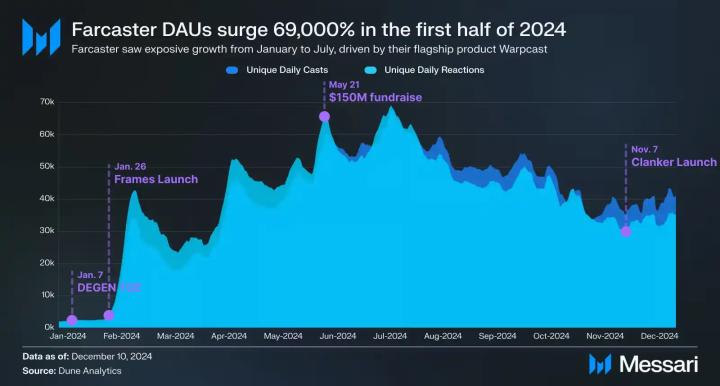
Farcaster entered 2026 with a headline valuation hovering near $1 billion, yet its daily active user (DAU) count remains modest. According to data from The Block and independent trackers on Dune, the number of real, non-spam daily active users sits around 5,000. This figure is derived from public API endpoints that track power badge holders, a proxy for genuine participation rather than bot activity or dormant accounts.
This disparity between valuation and usage highlights a common challenge in the decentralized social space. High valuations often reflect potential and network effects rather than current revenue or engagement. For Farcaster, the ~5,000 DAU count indicates a niche, albeit dedicated, community. It is not yet a mass-market platform, but it has established a stable core of users who value censorship resistance and data ownership.
Neynar Acquires the Protocol
In January 2026, Neynar, the infrastructure company that already powered most of Farcaster's ecosystem, acquired the entire protocol. The deal, valued near $1 billion, marks a structural shift from founder-led experimentation to centralized infrastructure control. This move consolidates the technical backbone under a single entity, fundamentally altering the governance model that initially attracted early adopters.
The acquisition coincides with the departure of co-founders Dan Romero and Varun Srinivasan, who left to join stablecoin startup Tempo. Their exit signals a pivot away from crypto-native social media development, leaving Neynar to steer the protocol's future. While the acquisition stabilizes the underlying infrastructure, it raises questions about the decentralization ethos that defined Farcaster's early growth.
"In January 2026, Neynar... acquired the whole thing." — Joan Westenberg, Thoughts on Farcaster
The impact on daily active users (DAU) remains a point of contention. While official metrics are sparse, data from the Farcaster client's public API suggests approximately 4,387 active users with power badges, a figure that roughly corresponds to non-spam DAUs. The acquisition's long-term effect on user retention and platform vitality will depend on how Neynar balances infrastructure efficiency with the open, decentralized nature of the protocol.
Founders exit and Tempo pivot
The departure of co-founders Dan Romero and Varun Srinivasan to focus on stablecoin infrastructure further underscores this pivot. Their move signals a strategic shift away from pure social media expansion toward broader blockchain payment solutions. This transition may impact how the platform is perceived in the short term, as the social layer becomes less central to the founders’ immediate efforts.
Farcaster vs Twitter for creators
For creators, the choice between Farcaster and Twitter (X) comes down to a trade-off between reach and control. Twitter offers a massive, passive audience but treats your content as a rental. Farcaster offers a smaller, more engaged community where you actually own your social graph and can monetize directly.
Ownership and data portability
On Twitter, your followers and history live on X's servers. If the algorithm changes or your account is suspended, you lose your audience. Farcaster stores your data on a decentralized network. You can take your profile, followers, and messages to any client that supports the protocol. This means your reputation is portable, not locked into one platform.
Monetization mechanics
Twitter monetization relies on ad revenue sharing, which is often opaque and requires strict adherence to platform rules. Farcaster enables direct creator-economy tools. Creators can sell access to channels, offer subscriptions for exclusive frames, or accept tips in crypto. The friction is lower for micro-transactions, but the total addressable market is currently smaller.
Community dynamics
Twitter is designed for broadcast; engagement is often driven by controversy or viral loops. Farcaster is designed for conversation. The culture is more niche and collaborative, with features like "frames" allowing interactive experiences directly in the feed. This fosters deeper connections but requires more active community management.
| Feature | Twitter (X) | Farcaster |
|---|---|---|
| Data Ownership | Platform-owned | User-owned (portable) |
| Monetization | Ad revenue share | Direct tips, subs, frames |
| Algorithm | Centralized feed | Chronological + client choice |
| Moderation | Platform-enforced | Client + user curated |
| Audience Size | Billions | Thousands (DAU) |
Twitter remains the king of mass reach, but Farcaster is building the infrastructure for creator sovereignty. If your goal is to build a business that isn't subject to a single platform's policy changes, Farcaster offers a compelling alternative, even if the audience is smaller. The trade-off is clear: scale on Twitter, ownership on Farcaster.
Community sentiment and mini-apps
The shift toward mini-apps is transforming Farcaster from a simple messaging board into an interactive application layer. Developers are building on-chain games, social tools, and utility bots that run directly within the feed, turning passive scrolling into active participation. This ecosystem growth is driven by a tight-knit group of builders who prioritize open protocols over walled gardens.
"Mini-Apps, community incentives, and a thriving developer ecosystem can position Farcaster as the world's first decentralized social operating system."
The sentiment among early adopters remains highly optimistic about this trajectory. While the platform has faced leadership changes, the developer community continues to innovate, focusing on user-owned data and composability. This grassroots momentum suggests that the next wave of growth will come from utility, not just conversation.
Farcaster 2026 FAQ
The landscape of decentralized social media is shifting rapidly. As Farcaster navigates its transition from a crypto-native experiment to a broader social platform, several questions regarding its user base, leadership, and origins have emerged. Below are direct answers to the most common queries based on current data and official announcements.
No comments yet. Be the first to share your thoughts!