
Farcaster valuation and funding shifts
The financial narrative surrounding Farcaster has undergone a significant recalibration as of early 2026. Following a period of intense speculative interest, the protocol’s corporate entity has moved from a peak valuation profile toward a more grounded, albeit lower, market standing. This shift reflects a broader correction in decentralized social infrastructure, where investor sentiment has transitioned from early-stage hype to a rigorous assessment of sustainable unit economics and user retention.
The transition to a mature valuation profile is closely tied to operational changes within the ecosystem. Co-founders Dan Romero and Varun Srinivasan recently announced their departure to join Tempo, a stablecoin startup, signaling a strategic pivot in leadership and focus. Concurrently, the protocol has eliminated its $5 account registration fee to lower barriers to entry, a move designed to stimulate organic growth in a market that no longer rewards speculative vanity metrics alone.
Market participants are now evaluating Farcaster not as a high-growth tech startup, but as a foundational layer 2 social protocol. The emphasis has shifted from rapid user acquisition to protocol stability and developer utility. While the billion-dollar dream has faded, the underlying technology remains anchored in Ethereum’s security model, offering a decentralized alternative to traditional social media giants. The current valuation reflects this reality: a mature, utility-focused network rather than a speculative asset.
Developer Migration from X to Farcaster
A critical supply-side driver for Farcaster’s 2026 expansion is the structural migration of developers and high-value users from centralized platforms like X. This shift is not merely a reaction to platform volatility but a strategic pivot toward protocol-level ownership. Unlike centralized social networks where user data is siloed and controlled by a single entity, Farcaster operates as an open protocol built on the Optimism Layer 2 network. This architecture allows developers to build directly on top of social graph data, creating a flywheel effect: more developers build tools, which attracts more users, which in turn attracts more developers.
The appeal for developers lies in the programmability of social interactions. By leveraging smart contracts, Farcaster introduces a layer of customization that centralized platforms cannot replicate. Developers can create applications that interact with user identities and social graphs in real-time, enabling features like on-chain reputation, decentralized identity verification, and seamless integration with crypto wallets. This technical foundation transforms social media from a passive content consumption model into an active, interoperable ecosystem. The result is a network effect that is harder to replicate and more resilient to external shocks than traditional social platforms.
The migration is further accelerated by the removal of financial barriers to entry. Farcaster recently eliminated its $5 registration fee, a move designed to lower the friction for new users and developers. This policy change, combined with the platform’s growing reputation as a hub for AI agent development, has made it an attractive destination for builders seeking to experiment with decentralized social infrastructure. The platform’s ability to support both human users and autonomous AI agents creates a unique environment for innovation, positioning Farcaster as a critical node in the future of decentralized social media.
Protocol Infrastructure and Security Architecture
Farcaster operates as a sufficiently decentralized social protocol built on the Optimism Layer 2 network. This architectural choice anchors the platform in the Ethereum ecosystem, leveraging its security guarantees while maintaining the transaction throughput necessary for social media interactions. Unlike traditional centralized platforms that rely on proprietary databases, Farcaster uses smart contracts to govern social interactions, introducing a layer of programmability and transparency to the network.
The reliance on Optimism ensures that user data and identity are not siloed within a single corporate entity. Instead, the protocol utilizes on-chain storage for critical state data, such as usernames and profile metadata, while off-chain solutions handle the heavier payload of message content. This hybrid approach balances cost efficiency with the immutable security provided by the underlying Layer 2 infrastructure.
Security in this context is defined by decentralization and censorship resistance. By distributing governance and data storage across a decentralized network, Farcaster reduces the risk of single-point failures or arbitrary content removal. The protocol's design allows clients to verify data integrity independently, ensuring that the social graph remains resilient against external pressure or technical outages.
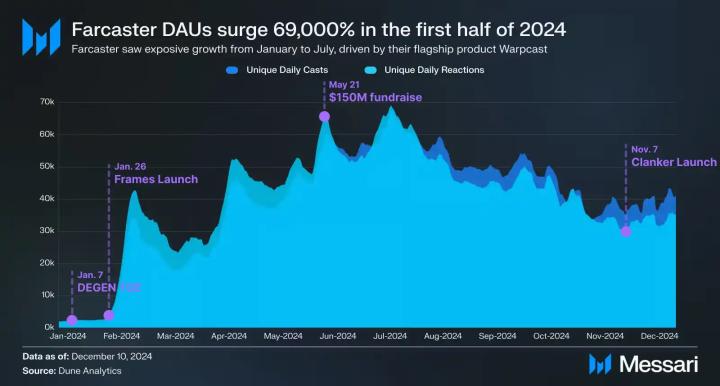
To assess the real-time health and market correlation of the ecosystem supporting this protocol, the following technical chart illustrates recent network activity and related token metrics.
Cost structure and free account registration
Farcaster has removed its $5 registration fee, a policy shift designed to lower the barrier to entry for new users. This change eliminates the previous friction point that required users to hold or purchase a small amount of cryptocurrency to mint a profile. By making account creation free, the protocol aims to accelerate user acquisition and expand its addressable market beyond the initial cohort of crypto-native participants.
The impact on user acquisition is immediate. Removing the financial hurdle allows for broader accessibility, particularly for users who are hesitant to engage with blockchain-based identity systems. This move aligns with the platform's goal of transitioning from a niche experimental network to a mainstream social alternative. The reduction in entry costs is expected to drive higher volume in new account mints, potentially increasing network effects and content diversity.
From a market analysis perspective, this policy change signals a maturation in Farcaster's growth strategy. While the $5 fee provided a small revenue stream and reduced spam, its removal prioritizes scale over short-term monetization. The protocol now relies on other mechanisms, such as developer fees and potential future subscription tiers, to sustain its infrastructure. This shift reflects a common pattern in decentralized social networks, where initial cost barriers are used to ensure serious participation before transitioning to free access to drive mass adoption.
Farcaster vs X: Key differences for users
The divergence between Farcaster and X represents a structural shift in how social data is owned and governed. While X operates as a centralized platform where the host retains ultimate control over content moderation and algorithmic distribution, Farcaster functions as an open protocol. This distinction fundamentally alters the user's relationship with their digital identity and network graph.
Data Ownership and Portability
On X, your follower list and historical posts are locked within the platform’s walled garden. Migrating to another service requires manually rebuilding your audience, as the social graph is not portable. Farcaster treats identity as a cryptographic asset. Because the protocol is decentralized, users can export their entire social graph and history, allowing seamless movement between different client applications without losing their network connections or content history.
Algorithmic Control and Censorship
X relies on a proprietary, opaque algorithm to curate feeds, prioritizing engagement metrics that often favor viral or controversial content. Users have no visibility into or control over these ranking signals. In contrast, Farcaster clients are open-source. Users can choose clients that prioritize chronological feeds, specific communities, or custom moderation filters. This decentralization makes the protocol inherently more resistant to centralized censorship, as no single entity can unilaterally delete the entire network or suppress specific viewpoints across all clients.
Market Context
The financial implications of this shift are reflected in the broader crypto market sentiment. As users migrate toward platforms that offer data sovereignty, the underlying infrastructure supporting these networks sees increased utility and valuation.
| Feature | Farcaster | X (Twitter) |
|---|---|---|
| Data Ownership | User-controlled (portable) | Platform-controlled (locked) |
| Feed Algorithm | Client-chosen (open-source) | Proprietary (opaque) |
| Account Portability | Full graph export/import | Limited (no graph transfer) |
| Censorship Resistance | High (decentralized protocol) | Low (centralized moderation) |
Cost and Access
Historically, Farcaster required a small fee to register a username, which acted as a spam deterrent. Recent updates have introduced free registration options, lowering the barrier to entry for new users. X, while free to join, operates on a freemium model where visibility and verification features are monetized through subscription tiers. The absence of a mandatory fee on Farcaster aligns with its ethos of open access, though users still incur gas fees for certain on-chain interactions depending on the client they use.
Technical Infrastructure
Farcaster is built on Ethereum Layer 2 scaling solutions, ensuring security and decentralization through smart contracts. This technical foundation allows for programmable social interactions, such as programmable casts or integrated financial actions. X relies on traditional centralized server infrastructure, which offers speed and reliability but lacks the transparency and auditability of a blockchain-based ledger.
Frequently asked questions about Farcaster
Is Farcaster safe and secure?
Farcaster operates on Optimism, an Ethereum Layer 2 scaling network, which provides a foundation of security and transparency through smart contracts. This architecture governs social interactions programmatically, ensuring that the protocol remains sufficiently decentralized. The use of smart contracts introduces a layer of verifiable integrity that distinguishes it from centralized platforms.
What crypto is Farcaster associated with?
Farcaster is built on Ethereum and operates as a public social protocol similar to X or Reddit. It does not have a native token; instead, it relies on Ethereum's infrastructure for settlement and data availability. This design choice aligns it with the broader Ethereum ecosystem rather than a standalone cryptocurrency asset.
Does Farcaster cost money?
Farcaster has eliminated its previous $5 registration fee, now offering free account creation. While the protocol itself is free to join, users may incur minimal gas fees for on-chain interactions depending on the client or gateway they use. This shift lowers the barrier to entry for new participants in the decentralized social space.
Who is behind Farcaster?
Co-founders Dan Romero and Varun Srinivasan launched the protocol in 2020. In early 2026, both announced their departure from Farcaster to join the stablecoin startup Tempo. This leadership transition marks a significant shift in the project's governance structure as it continues to mature as an open protocol.
No comments yet. Be the first to share your thoughts!